Showing posts with label blog book. Show all posts

Monday, April 8, 2013

The Blog Book Conclusion

What does your blog book color mean? We have been waiting for 4 weeks to see what the color of these blog books mean. Each color means something different. Each color will tell you to do something. I feel like we need to be more helpful in our lives. We need to help out more around the house. Our parents do a lot of the house work on top of having a full time job. So this blog book conclusion is going to help us get in that habit of being more helpful around the house. So without further delay, here is the Blog Book Conclusion!


Click HERE to see what your blog book color means! 
Post a comment after you complete your job telling us about how it went.

Monday, March 25, 2013

Blog Book #4: Pantheon

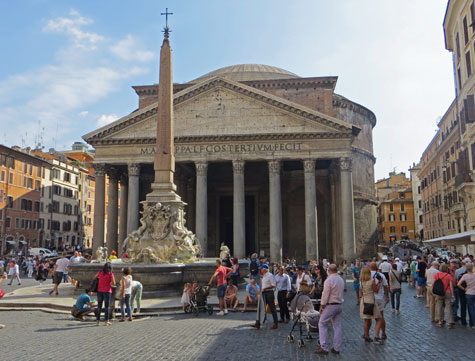
One of the most lasting buildings of the Roman Empire is the Pantheon. With its distinct look of the pillars in the front and the dome on top, the Pantheon has been a tourist hot spot in Rome for years. One of the most intriguing aspect of the Pantheon is the hole, called an oculus, at the top which lets in sunlight and is the only light source in the building. The pantheon was a place for worship for the ancient Romans. Below, you will find two articles to help you with your Pantheon blog book activity. For the Pantheon, we will be using the "hand" method.


Hand Method: In your blog book on the "Pantheon" page, you will fill out the Hand. Each finger will have a specific piece of information in it. The middle of the hand (the palm) will be a 3 sentence summary. Make sure you write in COMPLETE SENTENCES. See below for details:
Pointer Finger: Who ordered the Pantheon to be built?
Middle Finger:  What material was used to build the Pantheon?
Ring Finger: What is the hole in the roof called AND what it its purpose?
Pinky Finger: What does the word "pantheon" mean?
Thumb: How did the Romans build the dome part of the Pantheon? (hint: something to do with the thickness of the walls)
The Palm: Explain what the Pantheon was used for. (2-3 sentences)

Click here or here to find articles on the Pantheon that will help you fill out your "hand" notes.

Thursday, March 21, 2013

Blog Book #2: Emperor's of Rome

(Use this article to fill out your crossword)
I find it very fascinating to look at and study people in leadership roles. I find it interesting to learn how they got into that leadership position and how they handle their responsibility. I find it interesting to look at the decisions they make and the consequences. Over the span of this earth, there have been many people in leadership roles. Presidents, Kings, and emperor's. In ancient Rome, the leader of the Roman empire was known as an Emperor. An emperor is much different than the President of the United States, though they are both the leaders of the country and there have been both good and bad. Some can not handle the pressure and responsibility of leadership. Others strive as the leader. Some are crooked from the beginning, others get corrupted while in charge. We have discussed a few different emperors in class. Now, let us take this opportunity to learn about a few more emperor's of Rome. Like we discussed in class, some emperor's are good, some are bad. Some emperor's had great achievements like Vespian, who was emperor at the time of the Colosseum being built or Hadrian who order the construction of "Hadrian's Wall" and the famous Pantheon. Some emperor's were famous because of their father, like Tiberius who was the adopted son of the very first Emperor or Commodus whose father was Marcus Aurelius. Not only from a famous father, Commodus also fought as a gladiator, killing hundreds of animals, amputee's and wounded. Also, Commodus's opponents were told to lose on purpose being that he was the emperor. Emperor's like Titus witnessed one of the most tragic and sad events of the Roman empire, the disaster at Pompeii. Emperor Constantine had no famous physical structure, but an idea. Constantine brought the religion of Christianity into the Roman empire and made it equal to all other religions. A radical move for the times. Then, finally we have Justinian who formed the basis of all systems of law in the western world with the code he put forth. Good or bad, the Roman Empire saw many dynamic emperor's throughout its history.

Thursday, March 14, 2013

The Blog Book is Launched


Get ready for the never before used "Ancient Rome Blog Book." As we launch this new product on WSG, prepare yourself for some intense learning via the blog. With this blog book, you will use Water for Sixth Grade to fill it out. The blog book does not require you to post comments, but to use the posts or whatever is loaded on to the blog to complete the activity. In your blog book, you will be covering: mythology, public bath, Pantheon, roads, daily life, and emperors. Your blog book will be an essential tool for you in standard checks and the end of the unit test. Be sure to do a good job and keep up with the blog book activities. All blog book activities will be posted on the right side of WSG for easy access. 


Monday, March 19, 2012

Blog Book #1: Roads

Roads? Aren't roads kinda boring? Don't they just sit there on top of the earth and do nothing but provide a path for people to travel? Yes, that's basically what a road does. However, in Rome, that seemingly simple task was extremely important. Because of the vastness of the Roman Empire, roads were extremely important because the military, emperor, and others needed to be able to travel throughout the empire easily. With roads, the entire Roman empire was connected. The Romans built a lot of roads. Not only did they build a lot, but they also built GOOD roads. They revolutionized the way roads were built, taking it from a dirt path, to an actual road. For this blog book activity, you are going to learn about how the Romans made their roads. Simply click the link to see what the layers of the Roman road were, then label the activity in your blog book.
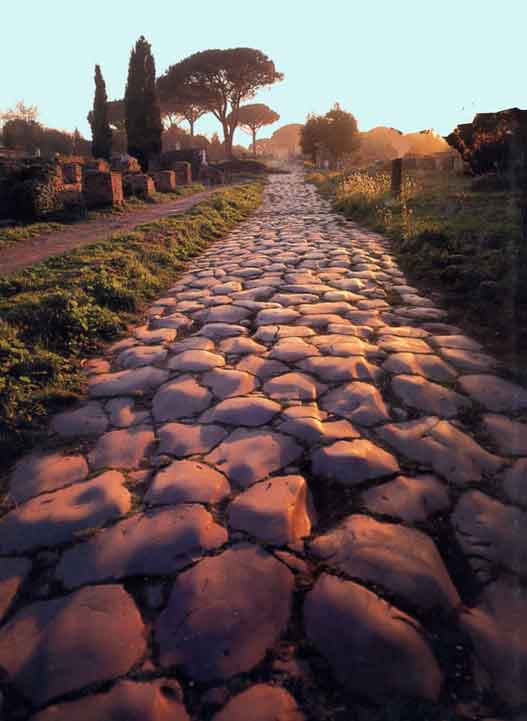
The picture you see is an image of the Appian Way, the most famous Roman road ever made.

In your Blog Book, you will complete two tasks for the "Roads" section.
1. *Click Here to see the different layers of the Roman Road. Use the picture to label the layers of the Road in your blog book.
2. Somewhere else on the Roads page, write down the following information:
*Appian Way: most famous Roman Road
*Roads important because they connected the huge Roman Empire.
*Romans needed a lot of roads so their military could travel quickly.
*Roman roads had a modern look: gutters and road signs.

Saturday, April 2, 2011

Blog Book #7: Conclusion


Well, students, here we are. We have reached the end of our Blog Book. The only thing we have left to do is the conclusion. For the past three weeks, you have all waited patiently to find out what the color of your blog book means. Well, wait no longer as I am now ready to reveal the meaning. Each color means something different. No matter what color you have, your conclusion will be awesome and I can't wait to see what happens. Many people will be very happy with me, it just might not be you :) So, without further delay, click the link and discover what your conclusion will be.

#7: Blog Book Conclusion: On the back of your blog book, write down what your task is, then a line for your parent to sign it. If you do not do the conclusion and do not have your parents signature, your blog book will result in a zero. So DO IT!

ROME BLOG BOOK CONCLUSION

Wednesday, March 30, 2011

Blog Book #6: Public Baths

The Romans were not shy. The public baths were a place of great popularity and socializing. In our world, if people wanted to hang out and socialize with friends, they might go to a resturant. Not the case in Rome. People in Rome went to the baths. Sure, these people took baths there, but they also did many more things. Copy this list down in your blog book for your "Public Baths" page:
Facts about the Public Bath:
1. It was very expensive.
2. The baths also included a library, exercise rooms, saunas, and hair cutting rooms.
3. Slaves would help the people.
4. The men and women would attend the baths at different times of the day.
5. Children could not use the baths.

Monday, March 28, 2011

Blog Book #5: Roman Mythology


Thursday, March 24, 2011

Blog Book #2: Pantheon

One of the most lasting buildings of the Roman Empire is the Pantheon. With its distinct look of the pillars in the front and the dome on top, the Pantheon has been a tourist hot spot in Rome for years. One of the most intriguing aspect of the Pantheon is the hole, called an oculus, at the top which lets in sunlight and is the only light source in the building. The pantheon was a place for worship for the ancient Romans. Below, you will find an article to help you with your Pantheon blog book activity. For the Pantheon, we will be using the "hand" method of note taking.


Here's how the hand method works: As you read through the article, write down one fact in each of the five fingers. Then, in the middle of the hand, write a quick 3-4 sentence summary of the Pantheon, focusing on the most important aspects.


Click here or here to find articles on the Pantheon that will help you fill out your "hand" notes.

Saturday, March 19, 2011

"All Roads Lead to Rome" (Blog Book Roads)

Roads? Aren't roads kinda boring? Don't they just sit there on top of the earth and do nothing but provide a path for people to travel? Yes, that's basically what a road does. However, in Rome, that seemingly simple task was extremely important. Because of the vastness of the Roman Empire, roads were extremely important because the military, emperor, and others needed to be able to travel throughout the empire easily. With roads, the entire Roman empire was connected. The Romans built a lot of roads. Not only did they build a lot, but they also built GOOD roads. They revolutionized the way roads were built, taking it from a dirt path, to an actual road built with stones, mortar and blocks. Whenever the Romans would conquer another town or city, they would build a road back to Rome. So the phrase, "all roads lead to Rome" was actually true during this time period. The picture you see is an image of the Appian Way, the most famous Roman road ever made. As you can see, the Appian Way, like most of the Roman roads, were built in a straight line. They were also built with gutters and roads signs showing how far it was to Rome. The gutters and road signs gave the Roman roads a modern day look. 

In your Blog Book, you will complete two tasks for the "Roads" section.
1. *Click Here to see the different layers of the Roman Road. Use the picture to label the layers of the Road in your blog book.
2. Somewhere else on the Roads page, answer the following questions with COMPLETE SENTENCES:
     1. What is the most famous Roman Road?
     2. Why were roads so important to ancient Rome?
     3. How did the Romans revolutionize (change) roads? 
     4. What gave the ancient Roman roads a modern look? 

Monday, March 14, 2011

Rome Blog Book #4: "Daily Life"

Time to focus on Daily Life. In class, you will explore the Roman's daily life of entertainment, education, and housing. For your blog book, your Roman daily life focus will be on clothing. Using the attached website, read about the clothing of the ancient Romans. The article will talk about clothing style for men, women, and young people. The article will also discuss hair styles, jewelry, etc. For your activity, you will compare the clothing style of the ancient Roman's to the clothing style in 2012. You will point out similarities and differneces with a Venn Diagram. On the "Roman" side, simply list things about Roman's clothing style that is different than ours in 2012. In the "Clothing in 2012" side, list things about our clohting style that is different than the Romans. In the middle, under "similarities," list things that we have in common. You can compare your clothing style to theirs or just clothing style in 2012 in general.


Quantity: For each section of the Venn Diagram, you MUST list at least 3 things.
***Important: If you put "wore Toga's" for the ancient Rome side, you can NOT put "do not wear Toga's" for the clothing in 2012 side.

Friday, March 11, 2011

Ancient Blog Book Begins!


Get ready for the never before used "Ancient Rome Blog Book." As we launch this new product on WSG, prepare yourself for some intense learning via the blog. With this blog book, you will use Water for Sixth Grade to fill it out. The blog book does not require you to post comments, but to use the posts or whatever is loaded on to the blog to complete the activity. In your blog book, you will be covering many different topics. Each topic will be labeled. We will insert the topics as we go throughout the unit. You will be expected to get this blog book completed essentially outside of social studies, though from time to time, we will have "blog book catch-up days" in which we will be in the lab and you will have a chance to get caught up. If you ever miss blog book posts on WSG, simply look in the label cloud for "blog book" and you will find all the posts that are tied to your blog book. Finally, this is going to be a very valuable resource as we go through the Rome Unit, so be sure to do a good job, which I know you will.

Good Luck and as always, thanks for being such rockin' students.