Wednesday, March 30, 2011

Blog Book #6: Public Baths

The Romans were not shy. The public baths were a place of great popularity and socializing. In our world, if people wanted to hang out and socialize with friends, they might go to a resturant. Not the case in Rome. People in Rome went to the baths. Sure, these people took baths there, but they also did many more things. Copy this list down in your blog book for your "Public Baths" page:
Facts about the Public Bath:
1. It was very expensive.
2. The baths also included a library, exercise rooms, saunas, and hair cutting rooms.
3. Slaves would help the people.
4. The men and women would attend the baths at different times of the day.
5. Children could not use the baths.

Blog Book Conclusion: Color Time!

With the conclusion of the Blog book activity, we are going to branch out a little bit from ancient Rome information. Water for Sixth Grade usually focuses on social studies and learning about ancient civilizations. WSG not only wants students to learn social studies, but also to become better people. It is time for you to work on being a person of strong character. The last activity for your blog book is determined by the color of book you have. Each color means something different. All assignments, however, are designed to help you become a better person. All activities will call for you to do something unrelated to social studies, but very much related to life. Good luck to you as you embark on this very unique opportunity. It will be interesting to see what happens and to see what you learn from this experience.
DIRECTIONS: In your blog book, for activity #7, you must do the following: 1. Write down what you did and the date. 2. Write down how you felt after you completed the activity. 3. Get your parents to sign your blog book after completion of the activity. If your parents do not sign it, it will result in a zero.

Click HERE to see what your color assignment is.

***Your blog book will be turned in on Monday, April 4th, 2011 in class to all you to complete your conclusion activity over the weekend if you need to. Thank you.

Tuesday, March 29, 2011

Teach Timmers Ancient Rome = Earn Extra Credit

We have traveled far in the ancient Rome unit. Luckily, the ancient Romeans were master road builders, so our travels have been smooth. We have covered a lot of information in our Rome unit. Now, we have the opportunity to share our knowledge with not only the world, but with Timmers. It is now time for us to Teach Timmers about the wonderfuly amazing place we have been learning about for the last three and a half weeks. It has been decided that if you choose to Teach Timmers about Rome, you will receive extra credit in social studies. So, this could be a great opportunity for you to make sure you do well in the ancient Rome unit. If you choose to take this extra credit opportunity, here are the requirements: Requirements **Post a comment teaching Timmers about ancient Rome by telling him ONE fact from each of the following topics: 1. Rome Begins! 2. Roman Republic 3. Emperors of Rome 4. Gladiators 5. Colosseum 6. Punic Wars 7. Pompeii 8. Blog books topics 9. Chrisitanity 10. Give him some Roman numerals for him to try to figure out. Please consider this extra credit opportunity. It would be a great way to study for the test and gain some extra points as well. Good Luck.

Extra Credit Window of Opportunity closes at MIDNIGHT on April 1st, 2011

Timmers is waiting. Teach him!

Monday, March 28, 2011

Blog Book #5: Roman Mythology


Sunday, March 27, 2011

Blog Book #5: Circus Maximus

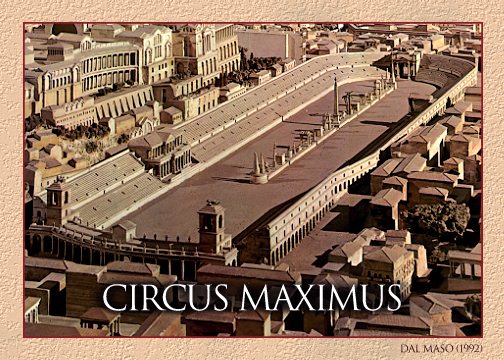
The name Circus Maximus is a leading misleading. It wasn't quite a circus like we think of when we hear the word Circus. It wasn't a bunch of fun and games with clowns, elephants, trapeez artists, etc. Though fun was had at the Circus Maximus, there were times of high intensity. The Circus Maximus served as the arena for chariot racing. This was a very popular thing in ancient Rome and though people who raced chariots were safer than gladiators, chariot racing could turn very dangerous. People were killed every so often during crashes. Unlike racing today, these chariot racers, or "charioteers" had no protective suits or seat belts. Instead, they were in the wide open chariots, with no protection against crashes. In your blog book, you will complete the second "hand notes" by filling it out with Circus Maximus notes. Just like you did with the Pantheon, write one fact in each of the five fingers, then a 3-4 sentence summary in the middle of the palm. Use the link to read about the Circus Maximus.
Click Here to read about the Circus Maximus.


Thank you and good luck!

Thursday, March 24, 2011

Showcase: Gladiator Trading Cards

Water for Sixth Grade would like to share with you a few Gladiator Trading cards. You, the student, worked very hard on your gladiator trading cards, and it was very difficult to choose what cards to share on the blog. Due to the amount of time it takes to scan the gladiator trading cards, it was not realistic to put every gladiator trading card on the blog. Therefore, a few have been selected from each class period to share. There were many, many great gladiator cards that didn't get chosen. There are many different types of gladiators from ancient Rome. Some were criminals, some were slaves, some were prisoners of wars, some were volunteers, and some were even Emperors! Emperor Commodus fought as a gladiator in the Colosseum but he only fought against amputees and the wounded and on top of that, his opponents were told to lose on purpose being he was the emperor. Click the link below to see a variety of Gladiator trading cards. It was defiantely very interesting to see what types of pictures were turned in. Like the students themselves, there was a wide variety of drawings.

Click Here to see Gladiator trading cards.

Blog Book #2: Pantheon

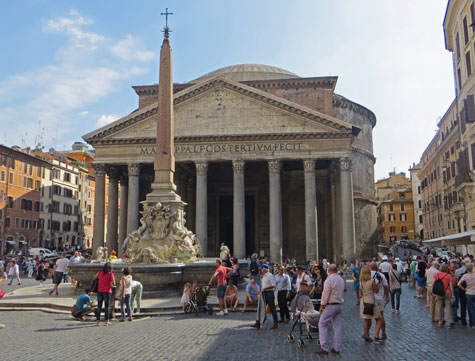
One of the most lasting buildings of the Roman Empire is the Pantheon. With its distinct look of the pillars in the front and the dome on top, the Pantheon has been a tourist hot spot in Rome for years. One of the most intriguing aspect of the Pantheon is the hole, called an oculus, at the top which lets in sunlight and is the only light source in the building. The pantheon was a place for worship for the ancient Romans. Below, you will find an article to help you with your Pantheon blog book activity. For the Pantheon, we will be using the "hand" method of note taking.


Here's how the hand method works: As you read through the article, write down one fact in each of the five fingers. Then, in the middle of the hand, write a quick 3-4 sentence summary of the Pantheon, focusing on the most important aspects.


Click here or here to find articles on the Pantheon that will help you fill out your "hand" notes.

Monday, March 21, 2011

Creating Rome Facebook

Facebook is an amazing website. Not only for what it offers, but by how many people use it. The number of people on Facebook is staggering: 600 million people. In fact, if Facebook was a country, it would be the third largest country in the world behind only China and India. Mark Zuckerberg, the creator of Facebook, has unbelievable vision to create something like this, and to take it to the heights it has soared. You see Facebook everywhere and it seems this is something that is not going away. I find it interesting and intriguing to take certain things and turn them into school projects. This is one of those examples. Let's take the idea of Facebook and turn it into something we can use with ancient Rome. Specifically, we will be using the "profile page" feature of Facebook. For us, we will be selecting topics of ancient Rome and making out own "Profile Page." Very important that you realize you will not actually be on Facebook, but instead, using a piece of paper. Ideally, we could all be on Facebook creating real profile pages of Rome, but that just isn't the way things work. This post is informational only, but I have attached the requirements of the project for easy viewing. On the right side, you will see a section called "Ancient Rome Websites." Use those to help you research on the Internet. Good Luck Facebook-ing Rome!

Read the Instructions on this assignment.

Blog Challenge: Unscramble the word, win a book!

Unscramble this word and win your own copy of Johnny Rawten. Be the first to post the correct answer and you are the winner! Good Luck!


Saturday, March 19, 2011

"All Roads Lead to Rome" (Blog Book Roads)

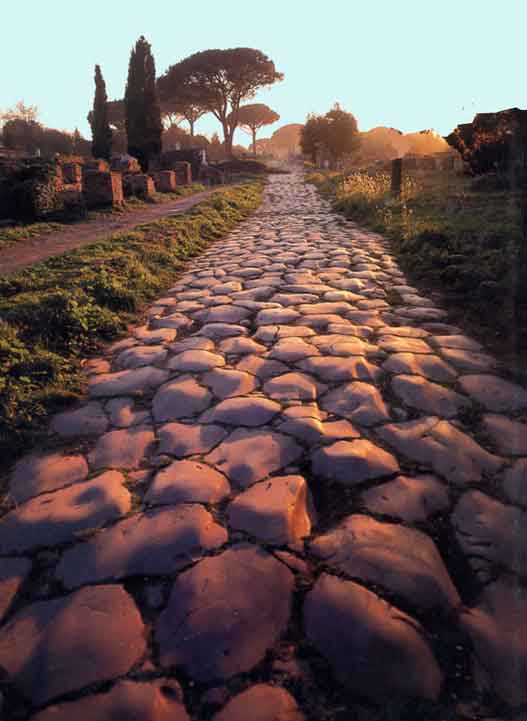
Roads? Aren't roads kinda boring? Don't they just sit there on top of the earth and do nothing but provide a path for people to travel? Yes, that's basically what a road does. However, in Rome, that seemingly simple task was extremely important. Because of the vastness of the Roman Empire, roads were extremely important because the military, emperor, and others needed to be able to travel throughout the empire easily. With roads, the entire Roman empire was connected. The Romans built a lot of roads. Not only did they build a lot, but they also built GOOD roads. They revolutionized the way roads were built, taking it from a dirt path, to an actual road built with stones, mortar and blocks. Whenever the Romans would conquer another town or city, they would build a road back to Rome. So the phrase, "all roads lead to Rome" was actually true during this time period. The picture you see is an image of the Appian Way, the most famous Roman road ever made. As you can see, the Appian Way, like most of the Roman roads, were built in a straight line. They were also built with gutters and roads signs showing how far it was to Rome. The gutters and road signs gave the Roman roads a modern day look. 

In your Blog Book, you will complete two tasks for the "Roads" section.
1. *Click Here to see the different layers of the Roman Road. Use the picture to label the layers of the Road in your blog book.
2. Somewhere else on the Roads page, answer the following questions with COMPLETE SENTENCES:
     1. What is the most famous Roman Road?
     2. Why were roads so important to ancient Rome?
     3. How did the Romans revolutionize (change) roads? 
     4. What gave the ancient Roman roads a modern look?